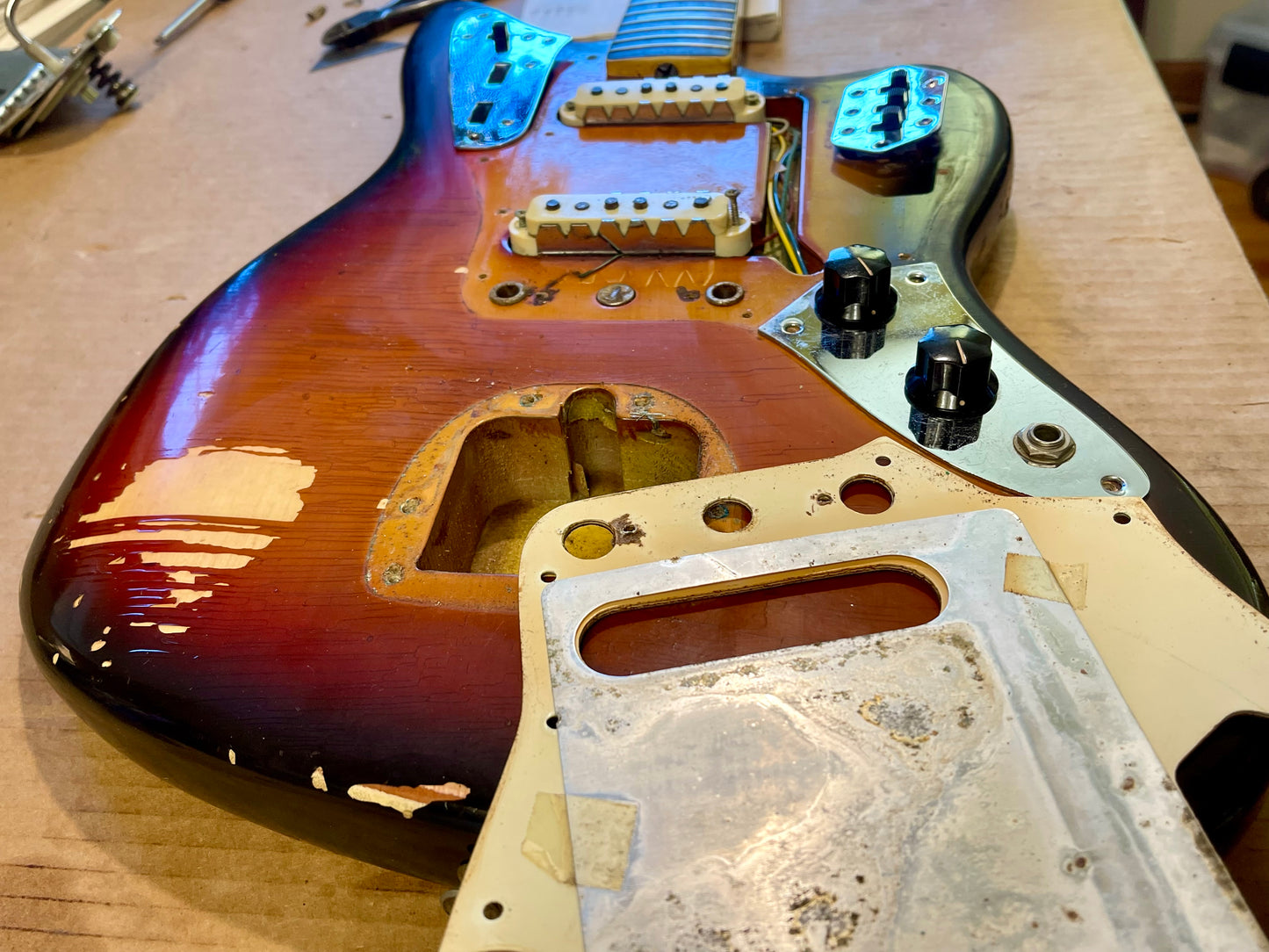
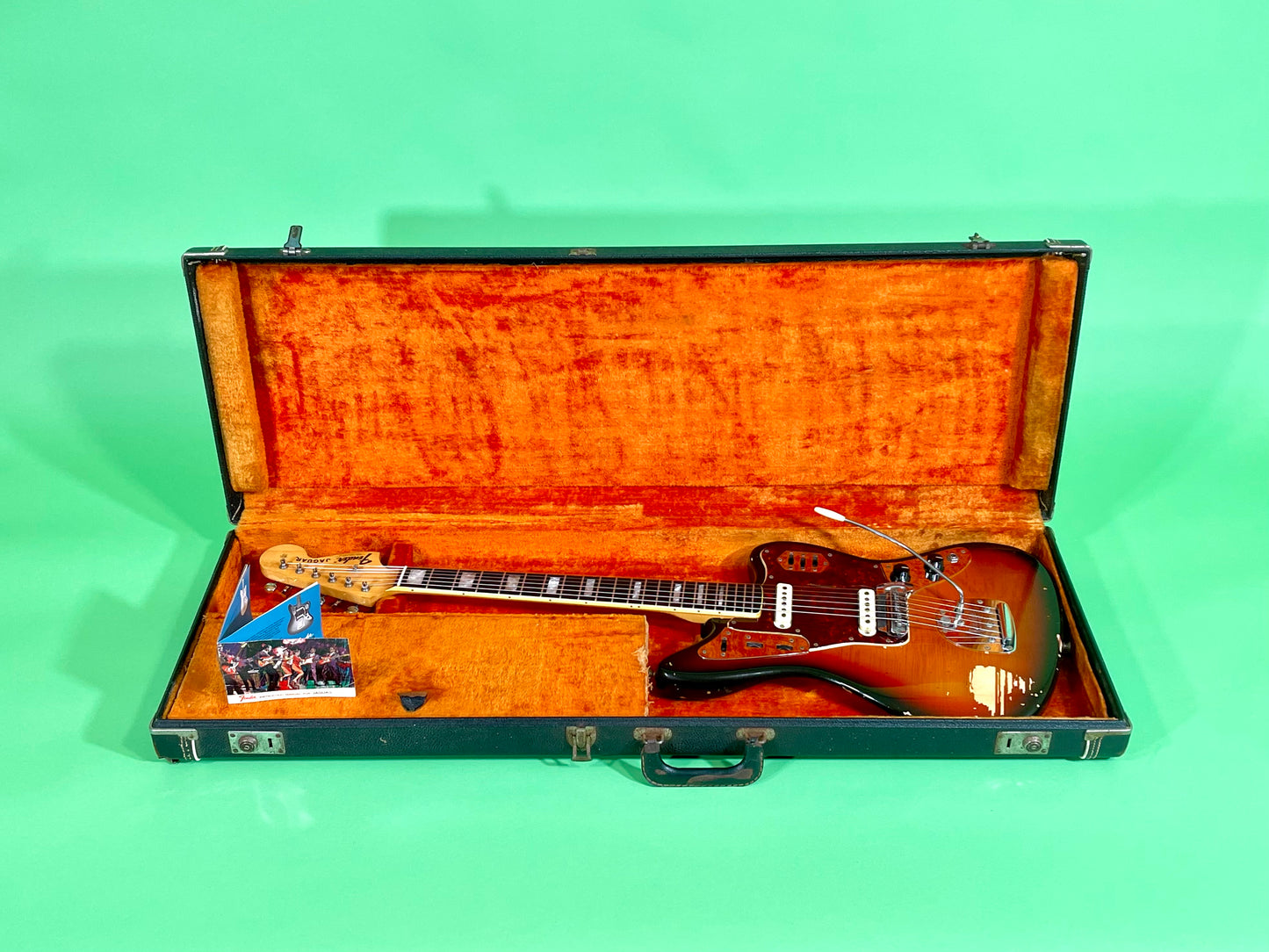
This Vintage Fender Jaguar is loaded with vibe and character that only a vintage guitar can get right. The finish has lots of line checking and handling wear on the top, sides and back. The 3-color sunburst transitions beautifully from a glowing amber in the center into the fire red outer-band and then to a black frosted edge. Just like all of the other Sunburst finishes that cam out of Fender back in the 60's, right? Well, not exactly. This 1969 Fender Jaguar wears what is a super-rare example of a factory-original "Faux-Burst" finish.
What's a Faux Burst? I'm glad you asked, get some coffee and pull up a chair.
Lots of misinformation out there on what exactly a "Faux-Burst" finish is, so let's clear that up right now. Most Fender guitar bodies from this era are 2-3 pieces of wood glued together. The wood may have defined grain that might look good with a transparent Sunburst finish-or it might not. It also might not match other pieces glued together. Historically speaking, Fender would use Ash wood bodies with high-contrast grain for "Blonde" finishes. Ash required additional preparation steps like pore filling which also added drying time (aka more costly-hey, time is money). The other favorite choice of wood-California Red Alder was cheap and abundant and as long as it had a nice visible grain, it was used for "Sunburst" finishes..If the grain was less than spectacular -the body would be used for a solid color. In the mid 1960's, the supply of nicely figured grained wood began to dwindle and subsequently-the suppliers instituted higher prices to match. Fender's answer was to just use less figured wood and showcase the color transition rather than feature the grain. This was done by adding white to the yellow in the center of the sunburst-and the red band also became more opaque. This era is often referred to as the "target burst" and became pretty well pronounced by 1966. The colors were bold and the lack of defined woodgrain was well hidden. Some customers didn't like that and requests began to pile up for a Sunburst finish with visible grain. Trying to keep the profit margin and customers happy, Fender came up with an idea: "Let's make our own grain!" The fastest way to do this was simple-paint the bodies White, then lightly streak darker brown lines longitudinally with a separated bristle paintbrush ...Prest-O! This made for a uniform base to spray the good ol' Translucent Sunburst over. It worked quite well-until it didn't. At some point in 1968-Fender experimented with a poly lacquer finish to replace the nitrocellulose lacquer in an attempt to achieve a more durable finish. Where a nitrocellulose lacquer would spray on relatively thinly-the poly went on like a wet blanket. It dried like one too... The nitrocellulose lacquer could gas out easily thanks to its composition, and provide a nice even appearance. The new poly finish dried incredible slow-mostly due to the thickness. Although the exact culprit is unknown-something caused a poor adhesion with the sunburst finishes, and the translucent coat would simply flake off in spots. This would happen within a few weeks of the guitar leaving the factory. Solutions were implemented including a reversion to nitrocellulose for the clear coat on all Sunburst finishes. But the problem persisted. Eventually, the poly was abandoned for a short time on all Sunburst finishes until the problem could be rectified. It would seem that the adhesion problem originated sometime in the body-prep stages, possibly a sealer that wasn't compatible with the later top coats. At any rate-the additional steps involving the "Faux Burst" were certainly a possibility, and as a suspected contributing factor to a production nightmare; the Faux Bursts were abandoned. Fender continued to struggle with consistent finishes well into the 1970's. Many times, combinations of water-based, nitro and poly were experimented with to various degrees of success-but that's another story.
Many Faux-Burst Fender guitars are 2 or 3-piece bodies just like all of their other guitars. Some people have speculated that Faux-Burst bodies are lots of small pieces of wood glued together but this is just nonsense. Others suspect that 'heavy wood' was used on Faux-Bursts...yes, painting it white and then painting wood grain would not effect the weight in ANY beneficial manner, so lets just stop with that nonsense also. This Jaguar is actually quite lightweight for an Offset-so there's that. So why a Faux-Burst? Simple-to provide an affordable product that the market wanted-same as always.
Eventually, Fender decided the best way to make high visible grain on a Sunburst finish was to start with a high-grain wood: Ash (this became common by 1976) Unfortunately for them-Ash can be heavy and guitarists don't like that...
Back to this Jaguar-this unit was produced at the original Fender factory in Fullerton, California U.S.A. in April 1969-according to the factory neck stamp. The guitar is 100% original and super-solid. Draggin' Guitars has carefully inspected and fully verified this Jaguar. It has been professionally set up and is ready to go-it needs nothing. I have never actually seen an original Faux-Burst Jaguar, this is the first one. All Faux-Burst Fender guitars are incredibly rare and collectible-and I'm sure there are other Jaguars out there possibly-but this one is certainly only one of a handful ever made.
The offset contoured body features the familiar silhouette that we know and love-is there anything cooler than a Jaguar shape? No, of course not. That's why we're here. The finish has lots of line checking, handling wear all over and killer vibe. You can see the Faux-Burst base clearly in the areas where the sunburst has left the chat. The contours are nicely shaped and the body is sleek and incredibly comfortable. The neck pocket has the requisite factory paint stick shadow, batch number 8 code and the double R stamping-one in each direction along with the ink circle inspection stamp. The original factory double shim is also in place.
The neck is smooth and perfectly straight. The neck profile is the typical vintage-C shape and measures .858" at the 1st fret and .910" at the 12th fret. The factory ink stamp on the heel reads "15"-Jaguar "APR 69" "B" -1 5/8" nut width (standard size)...the nut measures exactly 1.62" wide. The neck has a very smooth feel and there is some nice flame figuring present-see photos. The original F-key tuners function smoothly. The headstock and logo display very nicely. The rosewood fingerboard is nice and clean and has a soft feel. The Block position markers display very nice and really make for a classy vibe. The neck binding is also in great condition. This guitar was played with flat-would strings its whole life (YAY!) so the frets have an excellent height and appear near new-condition, see photos. The frets have been crowned and polished and are very happy. The action is set low for a fast and easy playing experience. The string height at the 1st fret measures .010" and a perfect .050" at the 12th fret. The string height is easily adjustable with the bridge if you should desire a personal touch. The guitar plays killer up and down the fingerboard.
The pickups have the quintessential Jaguar sound: bright and loads of chime with the Fender "bell" tone present. The pickups have a nice strong signal-the bridge reads 6.33 ohms and the neck reads 6.28 ohms. All of the controls function smoothly and quietly. The original potentiometers date to the 36th week of 1966. The wiring harness is a typical blend of cloth and vinyl wire-that fits the era perfectly. Original solder joints confirm the originality-see photos. The tortoiseshell pickguard is in excellent condition and very beautiful, with a nice vibrant coloring. The bridge, mute plate and vibrato are all in good condition, along with the rest of the control panel chrome-see photos. The vibrato functions smoothly and feels perfect.
The guitar is lots of fun to play-what a player! It has a nice balance and as previously mentioned-it is fairly lightweight for a Jaguar; it weighs 8.36 lbs. The guitar is perfect for on-stage, studio, song-writing and couch duty. The original hard case is included-and maybe that cool owner's manual if you ask nicely!